
A good board of directors is essential in any sector, leading the organisation from the front and guiding it towards its strategic goals. When the team works in harmony and individual members complement each other and collaborate successfully, the organisation reaps the benefits.
However, the opposite is also true. Writing in the Financial Times, Novaquest Capital Management chair Gerry Brown states that: “Ineffective boards bring enormous consequences for society. Misperceptions of risk have led many boards, and thus their organisations, into poor decision-making or worse.” So, what makes a good board of directors? This article explores this question and highlights the key elements you need within your team to achieve success in your field.
Key takeaways
- Be deliberate and balanced when thinking about board composition, doing what is right for the good of your organisation.
- True diversity goes beyond demographics to include diversity of thought and experience.
- Independence and institutional insight should coexist and can complement each other.
- The culture of your board is as important as the policies and procedures you put in place.
- Succession planning is key, as is developing the leadership skills and competencies of your existing directors and executive team, leading to smoother transitions.
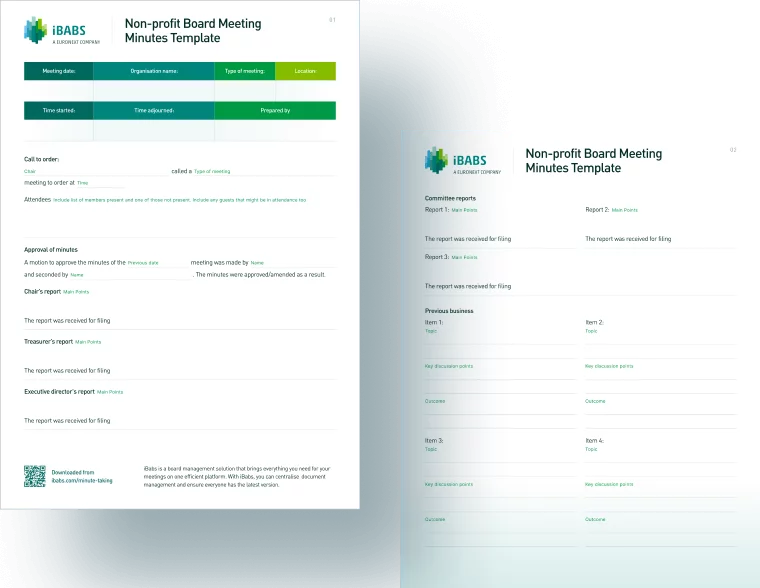
Meeting agenda, annual plan, board resolution and more templates to use in your meetings

What makes a good board of directors?
Board size and structure
All boards are different, reflecting the unique requirements of the sector and organisation, but it is important to find the optimal size for your board members. Too few members and you might find yourself without the required expertise. Too many members and it can hinder a smooth decision-making process.
Create a clear structure, with roles such as chair, treasurer, secretary and other leads, carefully considering how many other board members you require to lay the groundwork for constructive discussions and purposeful decision-making.
Board diversity
When your board displays diversity of background, experience and thought, you create an environment that is fertile for innovative problem-solving. Some boards make the mistake of limiting the scope of their diversity to merely demographic characteristics, but true diversity encompasses many different aspects that lead to better-informed and more rounded debates. Conduct a diversity audit to understand your current status and implement a board diversity policy to inform your recruitment procedures and help you fill competency gaps. This reduces groupthink and encourages your team to seek novel solutions.
Independence vs internal representation
Finding a good balance between external, independent directors and internal representatives of your organisations on the board of directors is the key to keeping objectivity at the heart of decision-making, whilst maintaining a connection rooted in the operations of the organisation.
Ensure there is a mix of impartial oversight and internal institutional knowledge on your board and carry out regular board evaluations to monitor whether the balance is working or requires adjusting.
Tenure and renewal strategy
Although experience is a valuable commodity on a board, having board members spend too long in a position can lead to stagnation and complacency. This requires you to manage board refreshment sensitively and in a constructive manner to ensure that you keep the flow of new ideas coming in without losing all touch with the progress made over the previous years.
Introduce term limits, but stagger them so you do not have to change the whole board at once and invest in succession planning to bring new candidates forward in a manner that allows them to acclimatise to the board’s culture before they join.
Cultural fit and values
Your board members should all be aligned and committed to the organisation’s mission, ethics and purpose. This doesn’t mean they must agree on how to adhere to those aspects – in fact, you want to showcase different opinions – but it is important that all members are working towards the same goal.
Make cultural alignment a key element of your recruitment strategy, creating a trusting and collaborative environment where each member understands that all arguments brought to the table are done so in the best interests of the organisation.

Director qualifications
Your ideal directors will possess a range of qualities that suit them to life on the board and help them make the best decisions possible for the organisation. These should include:
| Qualification | Explanation |
| Financial literacy and business acumen | Enables directors to understand budgets, financial reports and business strategies, supporting sound decision-making and financial oversight. |
| Industry-specific knowledge | Provides relevant insights into market dynamics, risks and opportunities in the organisation’s sector, informing better strategic guidance. |
| Legal and regulatory understanding | Ensures directors can navigate compliance obligations and reduce risk exposure by aligning decisions with applicable laws and governance frameworks. |
| Ethical standards and integrity | Builds trust and credibility, ensuring decisions reflect the organisation’s values and uphold accountability to stakeholders and the public. |
Board dynamics and culture
The way your leadership team interacts is important to the effective functioning of your board. There must be a mutual respect between members, where every director is willing to listen to all colleagues and consider their opinions before making constructive arguments to help the group reach a consensus or, at least, majority decision.
If there are members who refuse to accept the legitimacy of other directors and their input, you should take measures to guide them toward acceptable boundaries for meeting behaviour. This may require one-to-one discussion about their issues with the current board set-up and an explanation of the consequences of undermining their colleagues.
Encourage an open board culture where members communicate in a transparent manner. The chair should also be sensitive to power imbalances during meetings, making sure that a minority of members do not dominate and that those more introverted characters have a chance to express their views.
Governance practices
Introducing a governance framework into your organisation formalises the way that your leadership team functions. It creates the platform for decision-making and risk management, placing accountability at the heart of your board operations.
Make sure you put in writing how your board makes decisions, how your board works to meet compliance obligations and the internal processes you must use to fulfil the requirements of your business, too. List the internal controls and the mechanisms you will use to ensure you practise good governance at every step.
Create a code of conduct and ethics for board directors. This should include:
- Confidentiality clause to maintain the integrity of sensitive information
- Conflict of interest policy to dictate how to manage personal or professional interests that might affect decision-making
- Duty of loyalty and care to act in the interests of the organisation and its stakeholders
- Expectations of integrity and honesty
- Compliance with relevant laws and regulations to protect the interests of the organisations
- A pledge to work with respect and inclusion, displaying non-discriminatory behaviour whenever working on behalf of the organisation
- Guidelines for the responsible and appropriate use of the organisation’s assets and information
- A reporting mechanism to escalate complaints of unethical behaviour, along with assurances that the organisation will protect whistleblowers.
Role of the chair
The chair plays a key role in the success of the board of directors. Your board chair should have a clear understanding of their responsibilities within the organisation to help them bring the best out of their colleagues. This includes:
- Setting the tone for company culture
- Holding board members accountable
- Helping to develop the board meeting agenda
- Maintaining control of the agenda in the meeting
- Assigning action items to board directors
- Setting major goals and objectives for directors.
Each organisation will also have its own expectations of its chair, in addition to these key competencies.

Crisis management
A good board will be prepared for negative eventualities and have in place a crisis management plan that can kick into action immediately whenever needed. This requires forethought and planning from the board, including understanding the nature of the risks inherent in the organisation and its sector.
Plan for possible scenarios and develop plans for a response that maintains communication with stakeholders and reassures them that you have the situation in hand and can rectify issues as soon as possible. This preparation prevents there being so much pressure on time-sensitive decision-making. If all members understand the intended direction of travel, there is less risk of misstepping and increasing the damage to the organisation.
Director development and board succession
One important aspect of creating an effective board is the need for continuous improvement. You cannot stand still as a board that hopes to develop and meet the organisation’s future challenges.
You should ensure your directors take part in regular education programmes and skills updates, ensuring they are up-to-date with the latest governance developments, regulatory and compliance training and developments with the organisation and its sector. Run residential courses for your team to help with bonding and to make sure you make the most of their precious time for the good of the organisation.
Alongside this, you should develop the skills of your future directors. Be continuously on the search for up-and-coming talent, inviting them to work with your board members as mentors so they are ready to join the board when the time comes.
FAQ
What is the role of advisory boards and shadow boards?
Advisory boards provide non-binding strategic guidance and specialised expertise to an organisation’s leadership without holding formal governance power. Shadow boards, often made up of younger employees, offer fresh perspectives on decision-making and help bridge generational or cultural gaps.
What are red flags of poor board governance?
Red flags include a lack of transparency, rubber-stamping decisions without scrutiny, frequent conflicts of interest and minimal engagement from board members. Ineffective oversight and failure to challenge executive decisions are also warning signs.
Can a board be too independent or too involved?
Excessive independence may lead to detachment from operational realities, while an overly involved board risks micromanaging and undermining management. A balanced board supports strategic direction while respecting management’s role in daily operations.
How do you measure board effectiveness?
Board effectiveness can be measured through performance evaluations, measuring your progress against strategic goals or the quality of oversight and decision-making. Other indicators include director attendance, diversity of input, stakeholder trust and adherence to governance best practices.
Conclusion
Although every board is different because every organisation is different, there are many shared principles of what makes a good board of directors. This includes having a balanced structure with diverse insights and well-planned policies and procedures. The ability to communicate and collaborate openly and with mutual respect allows different viewpoints airtime and the opportunity to work constructively to find the best way forwards for the organisation.
iBabs is a board governance portal that allows directors to collaborate within the platform, working on documents to improve meeting preparation. The platform enables you to develop agendas in minutes, distribute minutes soon after the meeting and track action items for accountability. Request a demo of iBabs today.

