
Since the 2023 financial year, under Wet versterking decentrale rekenkamers, Dutch municipalities have been obliged to include a statement in their annual accounts explaining whether their income, spending and balance-sheet transactions followed the relevant financial rules.
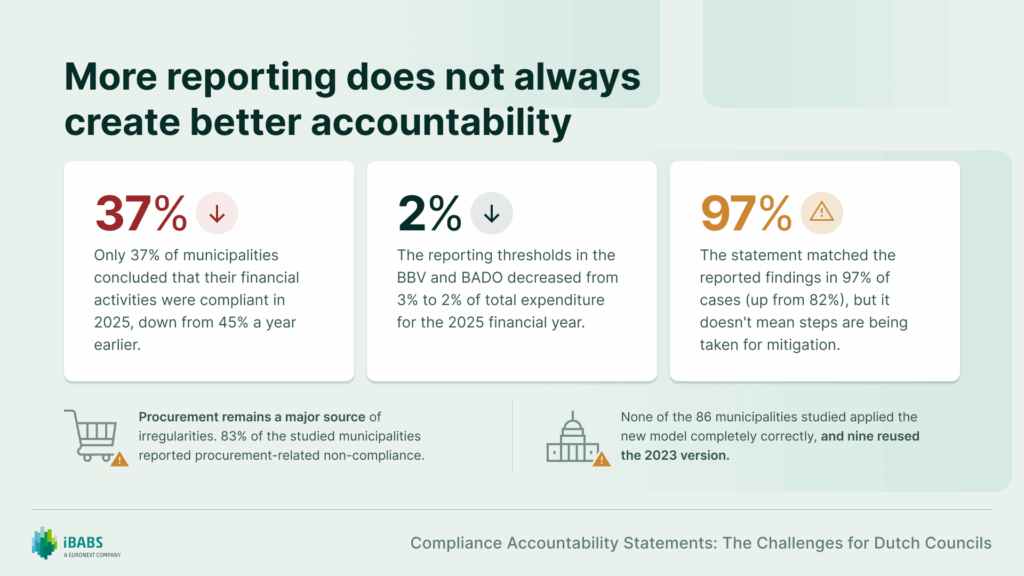
However, only 37% of the Dutch municipalities assessed in a 2025 report concluded that their financial activities were compliant, down from 45% the previous year.
The same research found that none of the 86 municipalities studied used the required accountability model correctly:
- Nine reused the previous year’s template
- 15 had not made their auditor’s report publicly available on their website.
These findings suggest that the compliance accountability statement for local government has exposed weaknesses in financial controls, procurement, budget management and the way councils document decisions throughout the year.
With the rules for reporting errors and uncertainties having been made stricter from the 2025 financial year, this article explains what changed and how your council can improve compliance by adjusting its current workflows.
Key takeaways
- Only 37% of the municipalities concluded that their financial activities were compliant in 2025, down from 45% a year earlier.
- The rules for the 2025 financial year lower the maximum accountability threshold from 3% to 2% of total expenditure, excluding additions to reserves.
- Councils must add financial compliance errors and uncertainties together when determining whether they exceed the threshold for reporting.
- Procurement remains a major source of irregularities, with 83% of the studied municipalities reporting procurement-related non-compliance.
- Councils need year-round controls and reliable records rather than trying to reconstruct decisions when preparing the annual accounts.
What is the financial compliance statement?
Since the 2023 financial year, the municipal executive has had to account for the compliance of the municipality’s financial management through the compliance accountability statement in the annual accounts. The statement tells the municipal council whether income, expenditure and changes to the balance sheet complied with:
- The budget approved by the council
- Relevant legislation and municipal regulations
- Rules intended to prevent misuse or improper use of public money.
The executive prepares the compliance statement and the external auditor checks whether the annual accounts, including that statement, present the position accurately and completely.
The aim is to allow the elected council to hold the executive to account. The statement should help councillors understand what went wrong, why it happened and what the executive will do to prevent it happening again.
In March 2025, the reporting thresholds and approval tolerances in the Budget and Accountability Decree (BBV) and the Decree on the Auditing of Decentralised Authorities (BADO) decreased from 3% to 2%. This means councils must report on any errors above that proportion of total expenditure.
Why are councils still struggling?
Financial pressure increases the risk
Municipalities are having to make difficult choices regarding services in the face of budget pressure. This means they are regularly having to make decisions under time pressure and either spending beyond their approved budgets or delaying planned activity in their jurisdiction.
In the study by consultancy firm Exilo, every municipality reported budget irregularities to some degree. However, although councils have become better at spotting these irregularities, they still arise faster than councils can resolve them.
The task now is to uncover where problems first enter the system and address them before they become budgetary errors. Common causes include weak budget monitoring, unclear responsibilities, late budget amendments and a lack of alignment between decision-making and scrutiny from the finance team.
More reporting does not always create better accountability
The research found that the conclusion in the compliance statement matched the reported findings in 97% of cases, compared with 82% the previous year. This shows an improvement in internal reporting consistency, but it doesn’t mean steps are being taken for mitigation.
When irregularities appear every year without clear ownership or corrective action, councillors may begin to see them as unavoidable rather than trying to tackle them. You can help prevent this by presenting the information in a way that inspires discussion and scrutiny. For each significant issue, explain:
- What happened and how much money was involved
- Which rule, budget or condition was not followed
- Why the control failed
- Whether the executive had authorised or corrected the position
- What action will prevent a recurrence.
The system has been difficult to apply consistently
Councils began using the financial compliance statement for the 2023 accounts before all the related rules had been finalised, which created uncertainty about how the statement and audit should work in practice.
That contributed to differences in how councils interpreted the rules and required outputs. This is evident in the fact that none of the 86 municipalities studied applied the new model completely correctly and nine reused the 2023 version.
Now that the framework is in place, you should review your process against it, rather than relying on the methods you developed during the transitional period.
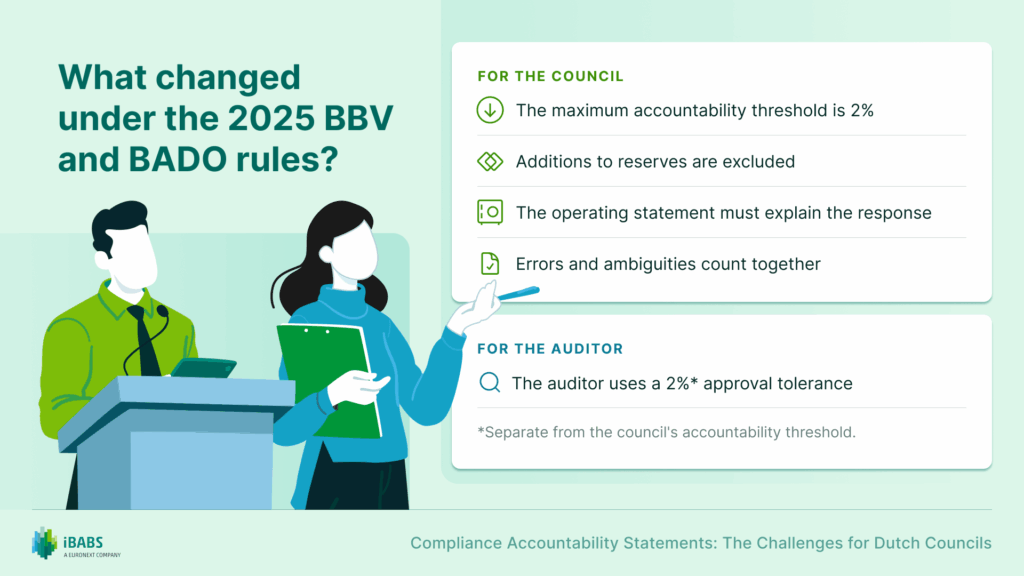
What changed under the 2025 BBV and BADO rules?
The revised rules complete the legal framework for the financial compliance statement and affect both council reporting and the external audit.
| Change | What it means for your council |
| The maximum accountability threshold is 2% | The municipal council must set the threshold for reporting financial compliance errors and ambiguities at no more than 2% of total expenditure. It may choose a lower percentage. |
| Additions to reserves are excluded | You should calculate the threshold using total expenditure without adding amounts transferred to reserves. This can produce a lower monetary threshold than under the previous method. |
| Errors and ambiguities count together | Add known financial compliance errors to transactions whose lawfulness the executive cannot establish with certainty. If the combined amount exceeds the threshold, include them in the compliance statement. |
| The operating statement must explain the response | The executive must provide further information about financial compliance and describe the measures it will take to prevent future errors and ambiguities. |
| The auditor uses a 2% approval tolerance | Under BADO, the auditor adds material errors in the annual accounts and audit uncertainties together and assesses them against a 2% tolerance. This relates to the auditor’s opinion on the annual accounts and is separate from the council’s accountability threshold. |
How to improve financial compliance
Update the rules and annual control plan
Start by checking whether the council has updated its:
- Financial regulation
- Accountability threshold
- Reporting threshold
- Framework of standards
- Internal control plan
- Standard compliance statement and supporting templates
Your framework of standards should identify the external legislation and local regulations that can affect your financial transactions. The internal control plan should then explain how your organisation will test compliance with those rules.
For example, the Financial Regulation of the Municipality of Wijchen states that the executive should check controls over assets and financial capital, provided that securities, inventories, outstanding loans, accounts receivable, liquid assets, loans taken out, short-term liabilities, and accounts payable on an annual basis.
Take into account 2026’s NBA Handreiking 1152 when preparing for the audit. Although the NBA guidance is written for auditors, it helps your controllers understand the evidence and presentation that the audit process will examine.
Focus on procurement risk
Procurement remains one of the largest sources of financial irregularity. The Exilo study found 83% of councils reported non-compliance in this area of its work. Common problems can arise when a council:
- Uses the wrong procurement procedure
- Extends or changes a contract without adequate review
- Divides related purchases into separate transactions and fails to consider their combined value
- Cannot show why it selected a particular procedure or supplier
- Starts work on a project before completing the required approval.
Procurement compliance, therefore, needs active monitoring throughout the contract lifecycle. Record the estimated contract value, applicable threshold, selected procedure, approval and reasons for any exception before committing any expenditure.
Connect budget changes to formal decisions
You might only notice budget irregularities at year end, but they usually develop much earlier.
When the council’s spending begins to exceed your approved budget, you should identify whether the executive or council needs to approve a budget amendment. They should then record the decision and notify the finance team promptly. A clear record should show:
- The original approved budget
- The change that created the pressure
- The amount involved
- Who approved the response
- When the council amended the budget
- Any conditions or follow-up actions.
Bring evidence together throughout the year
The financial system contains the transactions, but it may not contain the complete governance history behind them.
Supporting evidence can sit in procurement files, executive proposals, council papers, email approvals and separate action registers. This makes the annual compliance review slower and increases the risk of gaps because it is difficult to retrieve all the information in a short timeframe.
Create a shared evidence structure that links significant transactions and findings to their source documents. Agree on naming rules, ownership and retention requirements so controllers and auditors can retrieve the evidence without having to contact all relevant employees individually.
Keep internal findings visible
An issue identified by internal control should not disappear into a spreadsheet until the annual accounts are prepared. Use a central findings register to record the value of the discrepancy, what makes it irregular, how you should treat it, who is responsible and the action they should take.
Review this register during the year and update the status of issues so auditors can see that you have remedied them. This gives the executive time to correct processes, propose budget amendments and strengthen controls before the reporting deadline.
How decision documentation supports compliance
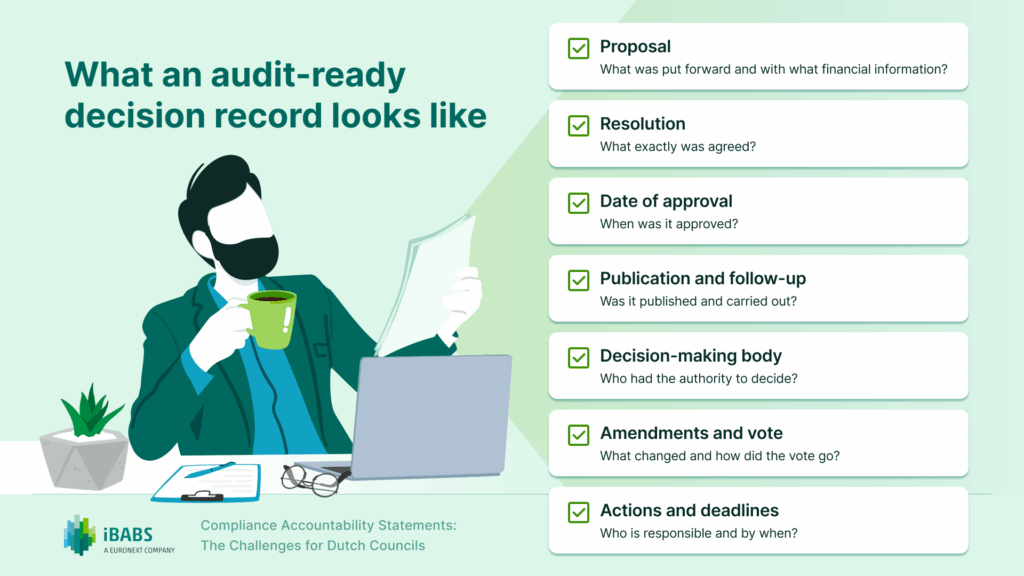
Meeting management software cannot replace procurement controls, financial systems or professional judgement alone. It can, however, preserve important evidence about how the executive and council made decisions relating to these issues. A reliable decision record can connect:
- The proposal and supporting financial information
- The competent decision-making body
- The final wording of the resolution
- Amendments and voting outcomes
- The date of approval
- Assigned actions and deadlines
- Published documents and later follow-up.
This can help when a controller needs to establish whether the council authorised a budget change, accepted an irregularity or instructed the executive to take corrective action.
Best practices for a stronger compliance statement
- Begin before year end. Review your findings quarterly and update the executive on emerging risks.
- Use the correct framework. Check the reporting year template, BBV requirements and local thresholds before drafting.
- Assign owners. Give each significant finding a named person responsible for investigation and corrective action.
- Preserve evidence at source. Store approvals, calculations and decision documents when the event occurs.
- Explain causes and improvements. Tell councillors why the irregularity occurred and how the executive will prevent a repeat.
- Discuss the findings politically. Give the council an opportunity to question the executive rather than simply noting the statement.
- Link systems where possible. Connect your financial findings to procurement records, meeting documents and formal decisions.
FAQ
Must every council set its accountability threshold at 2%?
The council may set a lower threshold through its local financial rules. Article 58b(4) of the amended BBV states that it cannot exceed 2% of total expenditure, excluding additions to reserves, for reporting from the 2025 financial year.
Do the 2025 BBV/BADO rule changes also apply to joint public bodies?
The changes to the BBV and BADO apply to municipalities, provinces and joint public bodies. Councils that participate in shared arrangements should ensure those bodies have also updated their compliance framework and accountability threshold to the new 2% ceiling.
What are the consequences if a council's accountability statement is found to be materially incorrect?
The auditor will issue a qualified or adverse opinion on the annual accounts. This triggers scrutiny from the council, potential follow-up by the audit chamber, and in some cases, intervention by the province as supervisory authority. Beyond the formal consequences, it also complicates future budget negotiations and erodes trust with citizens and councillors alike.
Conclusion
The municipal accountability statement tests whether the council can connect its financial transactions to effective controls, reliable evidence and accountable decisions. However, many municipalities appear to be struggling with the new requirements.
Councils need to update their frameworks, monitoring procurement and budget risks throughout the year and act on the findings before preparing the annual accounts. This gives the best possible opportunity to remedy issues and put in place new processes to prevent them from happening again.
Document decisions and demonstrate accountability
Good decision documentation supports that work. A central meeting and decision platform such as iBabs can preserve proposals, resolutions, approvals and follow-up actions in a structured record. Used alongside strong financial controls, it gives controllers, councillors and auditors a clearer view of what the council decided, why it decided it and what happened next.

