
On 1 January 2027, the Archiefwet 2026 replaces the Dutch Archives Act of 1995. That is only months away, and it is no longer a target date. The Eerste Kamer approved the bill on 12 May 2026 and the act was published in the Staatsblad on 19 June 2026, which formalised both the citation title and the commencement date.
The 1995 act was written for a paper reality. Today, emails, chat messages, collaboration files and datasets together form your organisation's institutional memory. The new act reflects that and requires you to manage digital information sustainably from the moment it is created.
This calls for a different way of working. Archiving is no longer something you arrange afterwards, but something you build in at the start. This article explains what changes, which organisations are in scope, what you need to keep and which mistakes to avoid.
Key takeaways
- The Archiefwet 2026 enters into force on 1 January 2027, replacing the Archiefwet 1995.
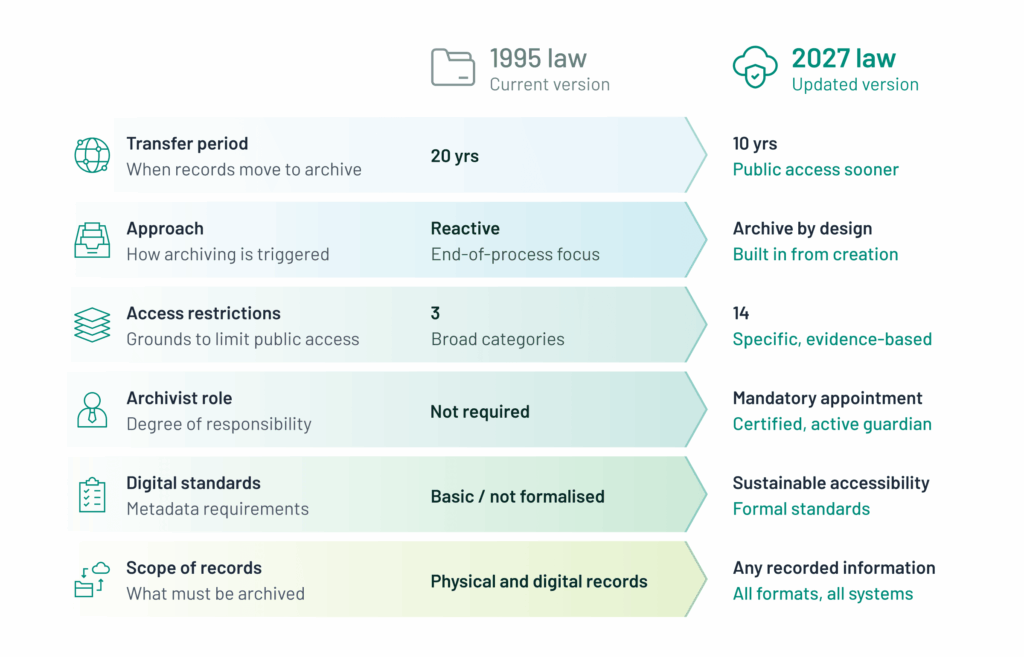
- The transfer period for permanent records drops from twenty years to ten, so information becomes publicly accessible sooner.
- You manage digital information sustainably from the moment it is created, rather than ordering it retrospectively.
- Archivable information is broader than formal paperwork: it covers any recorded information you create or receive while carrying out a public task.
- Supervision is being strengthened, and the Inspectie Overheidsinformatie en Erfgoed takes on a new role from 1 January 2027.
What is the Archiefwet?
The Archiefwet governs the sustainable accessibility and management of government information. Its purpose is accountability and transparency: citizens, journalists and elected representatives should be able to examine how your organisation carried out its public duties.
Under the 1995 act, records must be findable, complete, reliable and permanently accessible, whether physical or digital. Permanent records transfer to an archive repository after twenty years, where they become publicly accessible unless a specific restriction applies.
The Archiefwet 2026 shifts the emphasis towards sustainable digital management from the moment information is created. The transfer period becomes ten years, and the requirements for metadata, findability and durability become more concrete.
When does the new Archiefwet come into force?
On 1 January 2027. That date is the end point of a long process with several delays. Commencement was originally expected in 2024, then 1 July 2026. In November 2025, the then Minister of Education, Culture and Science told the Tweede Kamer that it would become 1 January 2027, because both the Eerste Kamer's scrutiny and the secondary legislation needed more time.
That date is now fixed. The Tweede Kamer approved the bill unanimously, the Eerste Kamer followed on 12 May 2026, and publication in the Staatsblad on 19 June 2026 confirmed the citation title (Archiefwet 2026) and the commencement date.
The Archiefbesluit and Archiefregeling, which set out in more detail how you apply the act, are being revised alongside it. (See editorial notes.)
Which organisations are affected?
The act applies to public authorities and to organisations that exercise public authority. "Government organisations" is a convenient catch-all, but the actual scope is more precise:
| Type of organisation | Examples |
|---|---|
| Public authorities | Central government, provinces, municipalities, water authorities and the High Councils of State |
| Public bodies and joint arrangements | Public bodies and joint organs established under the Wet gemeenschappelijke regelingen (Wgr) |
| Zelfstandige bestuursorganen (ZBOs) | Public-law ZBOs are typically in scope for all tasks and all information. Private-law ZBOs are in scope only for tasks where they exercise public authority, and for the records tied to those tasks. |
| Persons entrusted with public authority | In scope for the records tied to those public tasks |
The rule of thumb: if you are a public authority, the act generally covers your full information set. If you are not, but you do exercise public authority, it covers the records attached to that public task.
What is changing?
The role of the archivaris. The archivaris is the focal point for information governance and sustainable accessibility. The qualification requirement is being modernised, with more emphasis on training and professional development. The role shifts from supervising the process to actively steering its quality.
Archiving by design. You build archiving in at the point information is created, not afterwards. In practice, that means labelling a document for retention or destruction as you create it, and starting the appropriate workflow straight away.
A shorter transfer period. Twenty years becomes ten. Information reaches researchers and the public sooner, but the flip side is that your digital information management has to be in order ten years earlier. Postponing is no longer an option.
Digital findability and durability. You store digital information securely and keep it readable, findable and usable, even as systems change and technology ages. Metadata and preferred file formats are central to this.
Stronger supervision. Oversight of government information management is being reinforced. From 1 January 2027, the Inspectie Overheidsinformatie en Erfgoed will carry out interadministrative supervision of provinces on behalf of the Minister of Education, Culture and Science, extending in 2028 to joint arrangements in which provinces participate.
Different grounds for restricting access. The grounds for restricting public access after transfer become more specific, and you must be able to justify your assessment. (See editorial notes.)
What information must you keep?
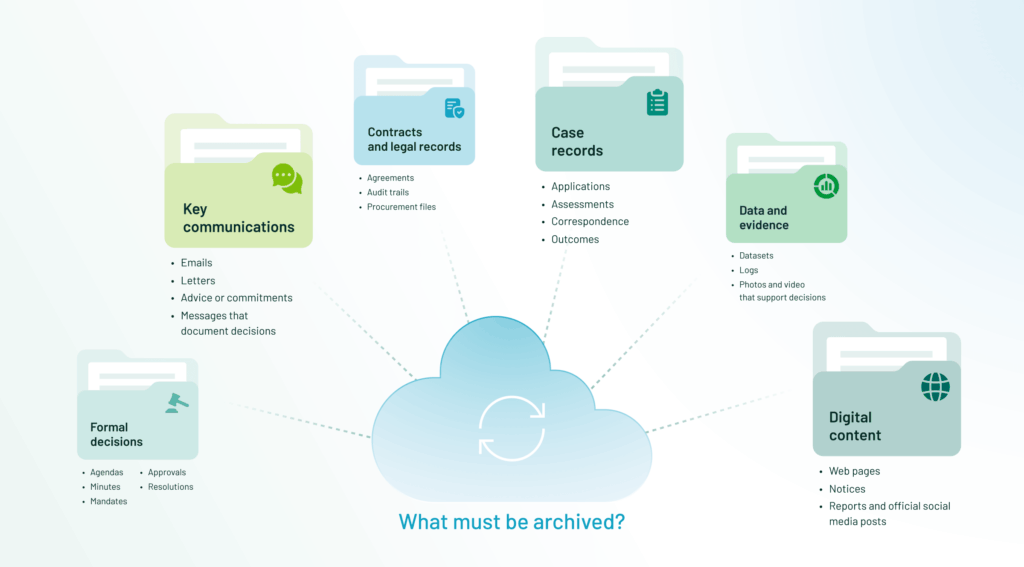
Archivable information is essentially any recorded information your organisation creates or receives while carrying out its tasks, regardless of format and regardless of where it sits: in line-of-business applications, on shared drives, in email, in cloud tools or anywhere else.
In practice, that includes:
- Formal decision records: agendas, meeting papers, decisions, mandates, approvals and minutes.
- Case and process records: files showing how you handled a matter end to end, such as applications, assessments, correspondence and outcomes.
- Contracts and legal or financial records: agreements, procurement files, audit trails and other official documents.
- Substantive operational communications: emails, letters and messages where they record decisions, commitments, advice, approvals, risks or accountability.
- Digital content and publications: web pages, public notices, reports and social media posts that form part of official communication or service delivery.
- Data and evidence: datasets, spreadsheets, logs, photos, audio or video that support decisions, actions, rights or later review.
Pay particular attention to chat messages. They are explicitly recognised as part of the institutional memory, and they are exactly the category that most often falls outside existing processes.
How do you store information sustainably?
Sustainable accessibility means someone can still find, open, understand and trust a record in ten or thirty years, even after your platforms have been replaced. That requires the right metadata and a controlled transfer to a digital archive.
The route looks like this:
- Start with MDTO. Metagegevens voor Duurzaam Toegankelijke Overheidsinformatie is the shared metadata standard describing what you record about a document or case file while it sits in your own systems. Think of it as a digital label: what it is, who created it, when, what it relates to, which version is final, what retention applies and whether access must be restricted.
- Prepare for transfer to the e-depot. An e-depot is the digital preservation system for long-term records. It keeps files readable as technology changes, protects authenticity and manages access rules so records become public at the right time.
- Package the transfer as a SIP. A Submission Information Package is the bundle you send to the e-depot: the files plus the metadata it needs to receive and register them properly. A good SIP prevents context from going missing.
- Structure the metadata for transfer. The metadata inside the SIP follows a fixed structure so the e-depot can read and validate it consistently. In short, MDTO determines which metadata you capture, and the transfer format determines the shape in which you deliver it. (See editorial notes.)
How long must you keep information?
That depends on how records are appraised in the selection list, and on whether they are designated for permanent preservation or eventual destruction.
Some information is kept permanently, such as policy-shaping advice and reports, certain permits and records of significant events. Under the new act, you transfer these to an archive service after ten years.
Selection lists
Every public body draws up a selection list, has it approved and follows it. To do that, you determine:
- how valuable the information is for your organisation;
- which considerations you record, so the public, journalists and elected representatives can follow them later;
- what the information might mean for future research and for people tracing the history of their family or area.
Most information is given a retention period ranging from a few years to several decades, and you destroy it once that period ends. That is not optional: keeping everything indefinitely creates risk and cost, particularly in light of the GDPR (AVG).
How the Archiefwet relates to the Wet open overheid
The Wet open overheid (Woo) and the Archiefwet both sit in the information lifecycle, but at different points:
- The Woo covers openness of information your organisation still holds: how people request it and how you publish proactively.
- The Archiefwet covers preserving and managing records, and access to them once transferred to an archive service.
In practice they reinforce each other. Strong archiving makes Woo compliance easier, because if you classify, retain and retrieve records properly, you can respond to requests faster and more completely.
Common archiving mistakes
- Treating archiving as end-of-process admin. This produces gaps and loses the context behind decisions.
- Using inboxes, shared drives and personal folders as the system of record. Official records scatter across tools with weak retention rules and inconsistent access control. That is both a security risk and a findability problem.
- Failing to capture chat and messaging when it contains decisions, instructions or substantive discussion, especially where teams use consumer apps for work.
- Missing or inconsistent metadata (who, when, version, status, case link). Without it, information stops being findable and explainable.
- Weak selection and retention discipline, leading to both over-retention and accidental deletion.
- Backlogs in disposal and transfer. These build up quickly and become expensive and risky to unwind, particularly during a system migration.
- Storing records in formats that are not future-proof, or managing migrations poorly. You end up with files you technically have but cannot open or rely on as evidence.
- Unclear ownership. If nobody can answer "who is responsible for this record set?", quality varies by team.
- No audit trail for key decisions and approvals, which makes it harder to show how a decision was reached, by whom and on what basis.
Protect your digital documents
The iBabs meeting portal is built for public sector organisations that want to offer transparency while keeping control of sensitive material. You build an audit trail of decisions and action items, publish voting results on your public portal, and make agendas and minutes findable so stakeholders can see why you decided what you did.
Everything sits in one place, so nobody has to reconstruct afterwards what was agreed.
Preparation roadmap
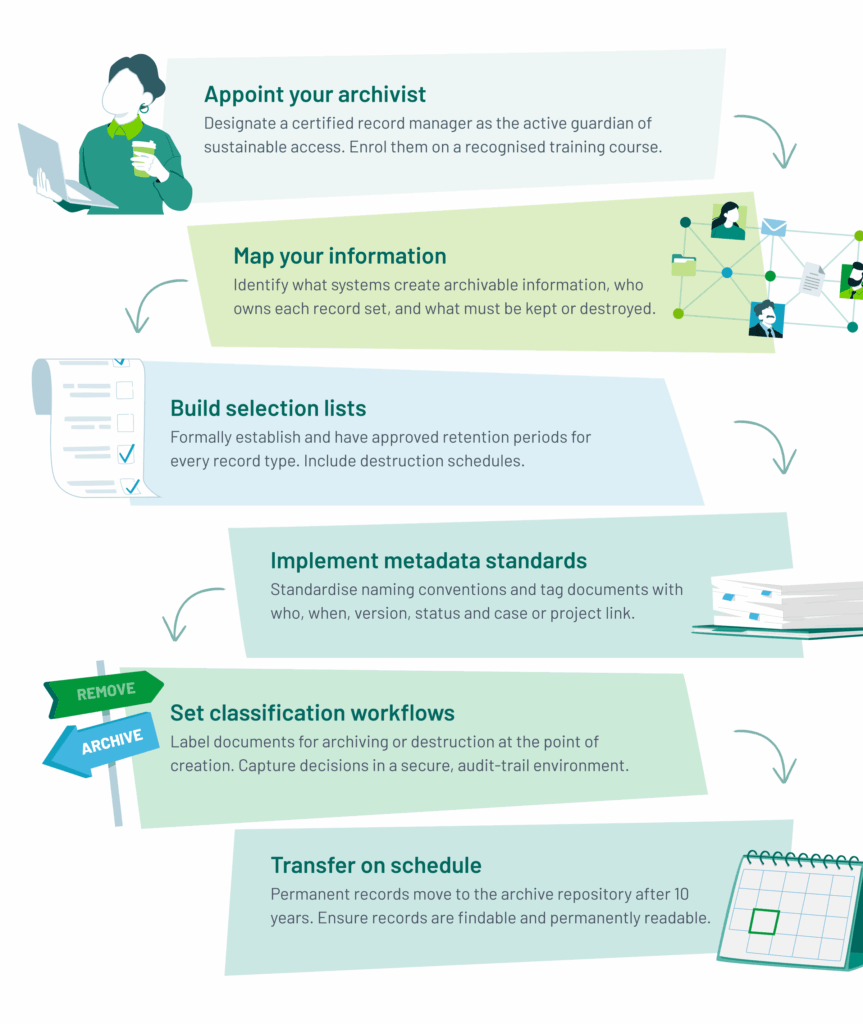
- Map what you hold. Where does information originate, who owns it and what must be kept or destroyed?
- Update your selection list and check that it aligns with the new transfer period.
- Assign ownership for each information set.
- Agree metadata and naming conventions and record them in working instructions.
- Connect to an e-depot and test a transfer with a limited set before it matters.
- Bring email and chat into your policy, including the use of messaging apps.
- Invest in the archivaris, with training and a position that allows early influence on the process.
- Check your file formats against preferred formats and plan migrations in good time.
How does iBabs ensure compliance with Archiefwet?
IBabs Archive is designed to help government bodies meet some of the requirements of Archiefwet.
- Store meeting agendas, minutes, votes and decisions securely
- Tag and categorise meeting documents to identify which items should be archived and which can be destroyed
- Input metadata into documents to ensure their searchability by external stakeholders
- Maintain version control to ensure you archive the correct iteration of important documents
- Restrict access to sensitive documents or to specific parts of those documents so you only share what is necessary.
- IBabs Archive is ISO 16175 compliant, adhering to the standards regarding high-level function requirements for software solutions that manage digital records.
FAQ
How does the Archiefwet handle privacy and access?
Transferred archives are open in principle, but access can be restricted for a period where disclosure would harm interests such as personal privacy, state security or commercial confidentiality. People can still request access, after which the archive service weighs the interests involved and may attach conditions.
For personal data, the GDPR (AVG) continues to apply. You manage access, retention and disclosure so that you protect data subjects while meeting your archiving duties.
What happens if you do not comply?
Supervision is becoming stricter. The Inspectie Overheidsinformatie en Erfgoed assesses whether organisations manage information properly and publishes its findings, which can lead to corrective action and political or administrative pressure. You also risk breaching the AVG or the Woo if you cannot protect personal data or retrieve information properly.
What should you do first?
Start by mapping your information and assigning ownership. That takes the longest and underpins everything else. Alongside it, settle how you record decision-making, because that is the information accountability later depends on.
Conclusion
The Archiefwet 2026 is settled and the date is fixed. The challenge is organisational rather than legal: archiving has to become a natural part of daily work instead of a task at the end.
Decision-making is a sensible place to start. Capture agendas, minutes, voting records and resolutions in one environment, apply the right labels and metadata, and make clear what is kept and what is destroyed. iBabs provides a secure environment with an audit trail of what was decided and why, so your organisation is supported rather than overloaded.
References and further reading
- Nationaal Archief, the new Archives Act
- Digitale Overheid, Eerste Kamer approves the new Archives Act
- Rijksoverheid, letter to parliament on the state of play
- Inspectie Overheidsinformatie en Erfgoed, supervision of provinces from 2027
- KVAN, Information and Archives Act theme page
- Gemeente.nu, new Archives Act from 1 January 2027

