
In the Netherlands, the Temporary Act on Digital Deliberation and Decision-Making provided the necessary legal basis for digital decision-making at a time when it was not possible to hold physical gatherings. Now that law has expired, the Tweede Kamer has adopted a permanent replacement – the Digital Meetings Act.
At the time of this writing, the Senate still needs to scrutinise and vote on the bill. However, if it becomes law, it will provide a permanent legal basis for decentralised authorities to hold meetings and vote electronically during exceptional circumstances. Where it is not possible to hold a physical meeting to discuss essential matters, it will mean that municipalities, water boards and other such bodies can make decisions without interruption. In the words of Member of the House of Representatives, Renilde Huizenga: "It is important that our democracy remains standing in times of crisis."
This article explains how the Digital Meetings Act will affect your organisation, when you can meet remotely and how to hold a valid and compliant digital meeting.
Key takeaways
- The Digital Meetings Act will give councils a permanent legal basis to meet and decide online when they cannot hold a physical meeting and the matter cannot wait.
- Fully digital meetings will be the exception, not the norm. Physical meetings will remain the default and the council judges when circumstances justify going online.
- The Act sets a high bar for what constitutes a valid digital meeting.
- The capability to meet online must be in place before the need arises so there is no delay in convening a compliant meeting.
- Some types of meeting must always be physical, such as swearing-in sessions and the appointment or dismissal of the mayor.

What is the Digital Meetings Act?
The Digital Meetings Act will allow municipal councils, provincial councils and water board general boards to hold meetings and take decisions remotely under specific circumstances.
It updates the Gemeentewet (Municipalities Act), Provinciewet (Provinces Act), and Waterschapswet (Water Boards Act) and sets the rules for when a council may meet digitally. It also provides guidance on which topics are allowed and what safeguards must be in place so online meetings meet the same standards of transparency as their physical counterparts.
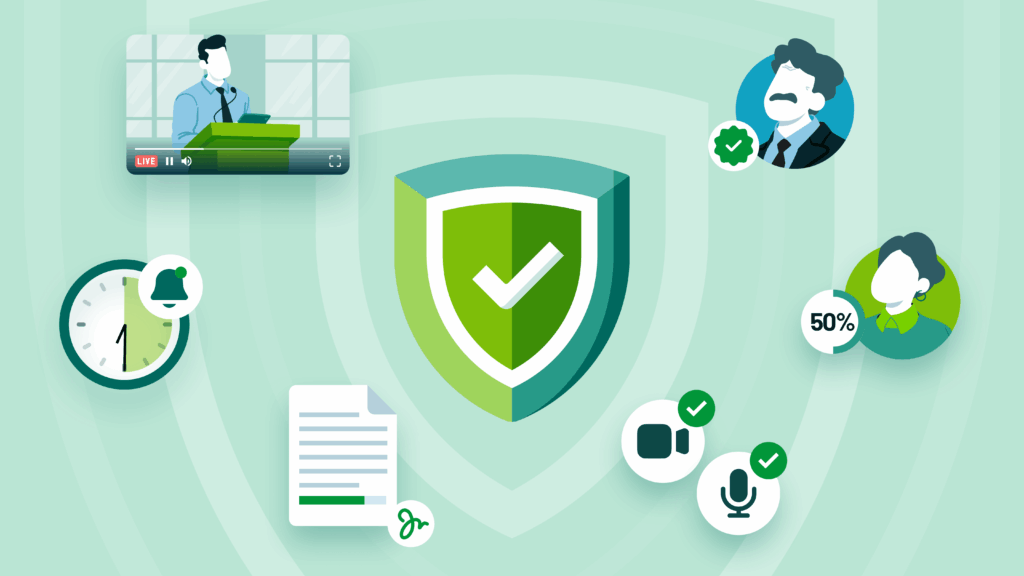
Requirements for meetings include:
- The public being able to follow the activity in the meeting in both vision and sound
- Establishing the identity of the participating members so they are both visible and audible
- Creating an attendance list to ensure a quorum is established.
The proposal also provides some exceptions where digital meetings are not allowed (for example, meetings with strong symbolic or procedural weight for closed meetings) and it places an expectation on councils to preserve public access to council meetings.
The bill was adopted by the House of Representatives in April 2026 and is in the Senate process.
When can a council meet digitally?
Under the bill, a council should only meet digitally when special circumstances make it not possible to meet in person and the council cannot reasonably postpone the meeting due to public interest.
It is for the council itself to justify holding a meeting remotely based on the specific circumstances at the time rather than in person, but official examples of valid situations include:
- When there is severe weather with a code red warning and when it is impossible or unsafe to travel to a venue
- During a public health crisis, such as a flu epidemic
- Where there is a concrete security threat.
In each case, the situation should be unforeseen, outside the council’s control and a genuine barrier to holding a physical meeting, rather than a matter of convenience. Here is a guide to what will and will not be permitted once the bill becomes law:
| Permitted | Not permitted |
| Fully digital meetings in special circumstances | Fully digital meetings as standard practice |
| The council deciding on a case-by-case basis when circumstances apply | A fixed statutory list of qualifying events |
| Digital decision-making where the meeting is open to public scrutiny | Closed meetings held digitally |
| Standard debate and voting items | Symbolic items such as swearing-in and mayoral appointments |
| Either a physical or a fully digital meeting | Hybrid (part physical, part digital) meetings |
What this means for council administrators
Council administrators must have in place processes to navigate the new rules when they come into law. This includes:
- Drafting new rules of order, or updating the existing document, to recognise the ability to pivot to digital meetings when appropriate.
- Appointing an individual or team to assess the special circumstances and decide whether the situation meets the threshold to take the meeting online, as well as recording this justification in case it is challenged later.
- Creating workflows to manage issuing a meeting notice, establishing a quorum, ensuring you identify all members and that the public can access the meeting in vision and audio.
- Having a digital meeting solution ready to use immediately when the situation arises and ensuring that all members are comfortable with how it works and how they can access the meeting.
Digital meetings, under the new law, are allowed to support the council in continuing its work rather than as a convenient alternative to physical meetings. It is the job of council administrators to establish that there is a strong use case for taking a meeting online and that it meets the requirements for a valid digital governance event.
How to ensure your digital meeting is valid
To ensure you meet the requirements of the Digital Meetings Act, you should:
- Announce the meeting publicly at least six hours before it opens.
- Only open the meeting once every member, the chair and the clerk can access the meeting platform.
- Confirm attendance and that it meets the quorum.
- Have sitting members join on their own devices to ensure you can identify them individually.
- Make sure that members are visible and audible so the chair and clerk can confirm who is present.
- Ensure the public is able to follow the meeting live in both video and audio.
Why a board portal is essential, for digital meetings and beyond
A board portal helps you run meetings that are valid, secure and properly recorded. Choosing a specific meeting management tool that offers video conferencing functionality is essential when you need to switch to a digital meeting at short notice, but it also improves every regular meeting through advanced security and collaboration.
Readiness for urgent digital meetings
Digital council meetings will happen under the new law because something unexpected makes an in-person meeting impossible and there is a public interest in the meeting going ahead. When that happens, you must be able to convene digitally with only six hours’ notice. However, you still need to:
- Confirm who is present and entitled to take part
- Verify each member’s identity
- Run a recorded vote
- Keep a clear record of decisions and minutes
- Provide public live streaming in both video and audio.
Consumer video calling tools can help you talk to each other, but they are not designed to follow stringent meeting procedures for identifying and recording attendance, running official voting that can be instantly logged digitally or creating a reliable audit trail in the short timeframe available. It can also not guarantee smooth and accessible public streaming.
A board portal is designed specifically for secure governance processes and record-keeping, helping you maintain control over the process, even when you are working at speed to change your meeting plans in an emergency.
Everyday value that improves all meetings
The same platform strengthens your day-to-day governance and meeting processes, whether you convene in person or digitally. With a board portal for your council, you can:
- Build and publish agendas and papers in one place
- Share the latest, correct version of every document with each attendee
- Allow members to make annotations, ask questions and propose motions before the meeting
- Capture decisions, actions and minutes in a consistent format
- Protect confidential documents with secure access control
- Keep an audit trail of what was shared, decided and approved
- Monitor members’ progress towards completing action items.

Checklist: Prepare for the Digital Meetings Act
The Digital Meetings Act still has some way to go to enter into law, but your council should put in place steps to prepare for it when it receives the royal decree. This includes:
- Adding a digital-meeting section to your rules of order so a meeting can be convened and run in a compliant manner.
- Agreeing in advance who decides that special circumstances apply and how you record that decision.
- Listing the meeting types that must stay in person, so they are never scheduled online by mistake.
- Confirming your meeting platform handles public live streaming, identity verification, presence lists and recorded voting.
- Setting up the six-hour public notice process so it can be issued quickly under time pressure.
- Briefing members, running a test meeting and offering digital-skills support so no one is caught out the first time a meeting has to go online.
FAQ
Who decides whether special circumstances apply?
The local representative body itself has the autonomy to determine if "special circumstances" exist and if a digital meeting is necessary. During discussion on the bill, Minister Pieter Heerma emphasised that local representatives are best positioned to weigh specific conditions, such as extreme weather, to decide if a physical meeting is reasonably impossible.
Can we just use a normal video calling tool?
While the law does not explicitly name or ban specific commercial tools, it establishes requirements, such as the ability to identify the participants visually and audibly and for live access to the meeting by the public. There may also be further technical obligations added before the Act passes into law.
Can individual councillors join remotely while the rest meet in person?
The current iteration of the proposed law does not allow for hybrid meetings where some people attend in person and others remotely. Earlier versions included a provision for this, but that was dropped before the bill went through the House of Representatives.
Conclusion
The Digital Meetings Act will create narrow, exceptional circumstances in which you can hold digital meetings within your organisation and physical meetings will remain the standard once the law comes into force. You will need to create procedures to ensure you can switch at short notice to virtual meetings that meet your obligations under the law and allow for public scrutiny.
Using iBabs’ end-to-end governance platform, you can enjoy streamlined distribution of papers, better collaboration and robust security. At the same time, you can also take advantage of the video conferencing functionality to see, hear and identify other members and iBabs Stream to webcast your meetings to the public with minimal manual work.
References and further reading
- Eerste Kamer dossier 36.558 – Wet digitaal vergaderen decentrale overheden
- Tweede Kamer dossier 36.558
- Tweede Kamer – debate summary on digital meetings.
- VNG – Wet digitaal vergaderen decentrale overheden
- Nederlandse Vereniging voor Raadsleden – digital meetings only by exception
- Nederlandse Vereniging voor Raadsleden – permanent digital meeting law

